Black Choreographers Festival: Here and Now 2026

Dance Mission Theater, March 1, 2026
Featuring works by Colutola Afolayan, Styles Alexander, Clarissa Dyas, William Brewton Fowler Jr., Mari Hester, dominique lesleyann, Raissa Simpson, dazaun soleyn
By Kristen Cosby
For the last two weeks of February, new and established artists staged original works at Dance MissionTheater in San Francisco as part of the 21st annual Black Choreographers Festival. A total of sixteen choreographers presented works over the two-week festival, a quarter of whom were newcomers to the festival’s stage, creating an essential platform for young choreographers to debut their works.
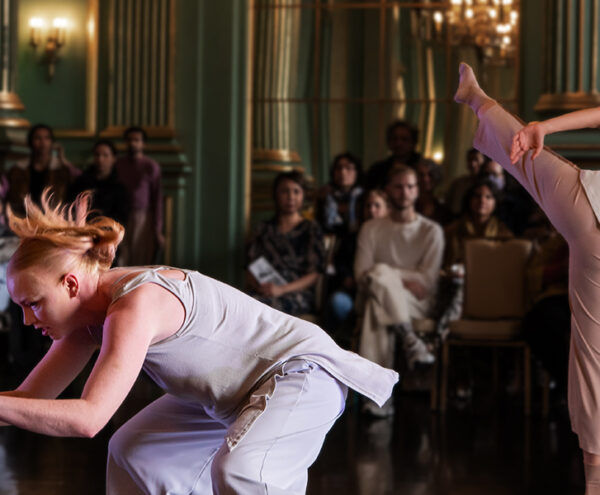
Two of these newcomers, choreographer and dancer Clarissa Rivera Dyas and dancer brooke terry, performed in tyTyrone, the night’s opening act. The piece explored the realm of alter-egos and doubling. Originally composed as a solo, Dyas incorporated a second performer (terry) to explore these themes of gender and alter-ego. They began in nude “female” undergarments, and both slowly rotated their bodies for the audience to fully appreciate their exposure and their forms. Their costumes revealed enough skin to make the audience look closely. The duo stared back with equal scrutiny.

They slowly and synchronistically clothed themselves in garments traditionally designated as masculine – baggy jeans, and white shirts – sometimes becoming trapped inside that clothing. With hoods up, they dragged each other across the stage by their hoodie strings, and in another moment they raised their t-shirts over their heads as if to remove them, and then remained with arms (still raised) and heads inside their shirts, as if they were children stuck mid-disrobing. In this pose, they pressed their torsos and still lifted arms together, briefly becoming a conjoined unit, which separated so they could dress, move, and eventually climb a ladder to a protrusion from the wall where they began head banging as if they’d just arrived at a concert.
The duet played with the tension of “what you do, I do,” alternating between mirroring, synchronizing and partnering, as if asking the question, what is an alter-ego? A private imagining? Another body? An idea that exists between a body and an observer?
Oakland-based dancer, choreographer Styles Alexander morphed performance art and dance and brought the audience to their feet, some of them weeping, with his performance as “DJ Nightmare” in 50/even. A DJ narrated from what appeared to be our own dystopian future, where earth has been nuked and he is in a bunker taking calls from the living and the dead, or dancing to R&B tunes, alone. “What did we do to arrive here? Nothing,” DJ Nightmare tells us, “We did nothing.”

During the finale, Alexander turned his back to the audience and slowly disrobed down to his dance belt. Vulnerably, and with a tinge of eroticism, he ascended a rickety scaffold and undulated his spine while on all fours before standing and draping a pale lacey green dress over one naked shoulder. A stage hand handed him a corded, unlit construction light which, when raised over his head, very suddenly transformed him into the embodiment of the Statue of Liberty.
“When in the Course of human events, it becomes necessary for one people to dissolve the political bands which have connected them with another, and to assume among the powers of the earth…” he recited from the Declaration of Independence, “... it is their right, it is their duty, to throw off such Government, and to provide new Guards for their future security… ” he continued, snapping on the light, which glowed red, as he spoke. He fell into silence and stood aloft in the red light, illuminating his figure of liberty which proved to be the most stunning image of the night.
Choreographer and performer Olutola Afolayan premiered the new solo work, The Crossing: My Trips to the Well. Utilizing stories of water, Afolayan established the experience of colonial diaspora through a narrative soundscape and the display of old photographs of generations of women forced from their homes, across rivers and boundaries. To bring these stories out of the past and onto the stage, Afolayan made use of a circle of old-fashioned wooden buckets that she moved between. Dressed in a simple white cotton frock, apron and turban, that harkened to the timelessness of the photos, she began with her back to the audience, kneeling and folded as if in prayer.
She utilized floor work for much of the piece, often snapping upright from a prone position

into a beautiful, defiant seated pose from which she glared at the audience with suspicion. Once upright, she dipped her hands into one of her wooden buckets and slowly bathed her face and clothed upper body, touching her arms and torso. In this cleaning, as photos of women washing or crossing rivers moved across the backdrop, the audience was allowed witness to a simple, ancient morning ritual of splashing water on the face, as the performer’s recorded voice spoke of a time before borders and crossings when people also washed this way.
In her work-in-progress, Nova Power: Peons, choreographer Raissa Simpson made use of lit-up rave glasses and varied plaid track suits to help render what might be an Afrofuturistic landscape. Her three dancers moved in a combination of hip hop and modern choreography, images of the same bodies dancing in bright fedoras appeared against the backdrop, competing for the viewer’s attention. It is hard to keep track of both realities. This viewer imagined that the world displayed on the screen also existed inside their glasses as some sort of augmented reality, since the competition for our attention between screen and stage seemed so poignant.
Simpson, one of the BCF’s founders and the founder of Push Festival, is one of the most established artists in the festival, and the nuanced performances of her dancers reflected this maturity in even their most subtle movements. What was noticeable in this landscape: no dystopia. Dancers Jermey Brooks, Ethan Dennis, and Erik K. Raymond Lee created gorgeous and beautiful fluid transfers of energy from one body to another. This itself

becomes a political statement inside this colorful piece – when bodies are whole and healthy and unfettered, they deftly communicate and shift meaning and energy without words or argument or conflict. Also, it’s just beautiful to watch a wave begin at the fingertips of one dancer and roll across their features down their opposite arm and through the person standing next to him as if they were one creature.
The most narrative piece of the night was Marianna Hester’s Divine Timing, featuring an all female ensemble dancing through a young girl’s life, performed beautifully by Jayde Rose. Bedecked in a school frock and backpack, Rose leaves her mother and sister and creates a family of friends as she travels and ages. As the dance progresses, all the women and girls who’d played her character and her friends come forth to create a circular formation with all the dancers balancing in penché developpé, bowing towards the center of their circle to the swell of Minnie Riperton’s Les Fleurs. While overt in its messaging and bold in its epicness, the moment resonates, and sends a ripple of very sweet girl-power vibes across the room, allowing viewers to imagine what if their different selves from years past met with each other? What if friends and loved ones could travel with you through time? How divine might that feel?
Just before the show, William Brewton Fowler, Jr., whose work, An Act of Trying, debuted during the festival, spoke briefly about the oddity of making a solo piece for his own body and superimposing it on another. In this work, as in all his pieces, he said, he tried to be incredibly vulnerable, and it’s a strange and difficult task to navigate a fellow dancer into that deeply vulnerable space.
Fowler’s was the most unadorned solo work of the night, the most modern, and the most delicate. This minimalism is distinct to this young choreographer: When I observe Fowler's works, I am always amazed at how through such “little” movement he allows me to feel such large emotions. On Sunday night, dancer Eli Shi embodied Fowler's choreography, his movements alternated between elegant and dramatic and quiet – he holds his head in his hands, we don’t know why he is frustrated, but he is. He splays his body across the floor, and at one point hurls a folding chair across the stage, only to retrieve it and quietly, calmly set it right.
In a night full of wild and gorgeous experiments, 222: divine timing was the evening’s hardest to define. The piece functioned as a duet, not between two dancers, but between two art forms sharing the same stage. On one side of the stage, choreographer and dancer Dominique Lesleyann balanced on her tailbone, low to the ground, then slowly began unfurling her limbs. Stage right, painter Adelf Uti stood at a large blackboard with a photograph of a man clipped to it, her back turned to the audience and her braids covering her face like a veil, as she steadily rendered the man’s image in chalk. Her pace was deliberate, almost devotional.

Thus the stage was divided: one side in motion, the other in meditation. While Lesleyann whipped her hair and then her body through space, volatile and searching, Uti continued her quiet accumulation of color, completing the drawing just as the dance concluded.
Much of the piece unfolded under a close-up projection of Nina Simone singing “Stars,” her voice thick with the knowledge that fame is rarely gentle or long-lived. Lesleyann met Simone’s sadness and Uti’s quiet with humor and a bit of sass. She tilted her hip and cast a conspiratorial glance over her shoulder towards the audience as Simone crooned, “Some women have a body men want to see.” Throughout the piece, Lesleyann’s movements responded or duplicated much of the lyric’s messaging, which at times felt like a dialogue and other times, more like repetition, but with so much to witness, it was impossible to disengage.
In may we heal?, the last piece of the night, dancers Jordan Ellis Dabney and dazaun soleynn began by building altars of grey brick bedecked with candles. They upended sacks filled with pink flower petals over the structures, creating altars of light and petals across the floor. Once built, they left the stage, and then returned, joined by dancer Claire-Fisher Mendez. Mendez’s and soleyn’s movements echoed each other while Dabney picked up a saxophone. In this very quiet, very patient finale, I found myself antsy. I’m not sure I believe we can heal, I realized. But after the show as I toured the altars, I found I was willing to retry my faith.


Comments