San Francisco International Hip Hop Dance Festival

Presented by Micaya
November 7-9, 2025
Palace of the Fine Arts, San Francisco
Artists: Threading Theatre, MUNA, Cie Konzi, Destiny Arts Youth Performance Company,
SoulForce Dance Company, Son of Iran, Create4
By Kristen Cosby
The ever-brilliant Micaya created and hosted the 27th annual San Francisco International Hip Hop Dance Festival at the Palace of Fine Arts in early November.
The festival brought seven different artistic groups to the Palace of Fine Arts for a two hour showcase that featured waacking, krump, house and other forms of hip hop artistry from the globe as part of this yearly multi-day dance extravaganza. Over a hundred groups applied, just nine are chosen. This year groups from the Netherlands, Norway, Belgium, and North Carolina attended alongside local acts such as Destiny Arts Youth Performance Company of Oakland, Str8jacket, and SoulForce.

In her own words, Micaya creates this gathering every year to “uplift community and preserve culture and inspire new generations of dancers.” In that she succeeded, as evidenced by the audience members of all ages who stepped onto the stage for a “Soultrain style” dance-off at finalé. The show displays what hip hop does best: it’s a form that lends itself well to a display of a wide variety of emotions in a direct way that is accessible and that uplifts energically even as it explores the hardest aspects of human experience.
Highlights of the night included Threading Theater’s Brothers which featured a male duo from the Netherlands who display the tensions, intimacy, connection, and fluidity of brotherhood through their work. By locking hands and threading first their arms, then their legs, and then their entire bodies through different portals created by each other’s forms, the two dancers tangled and untangled in so many ways that their movements seemed to never repeat. At times, they seemed to sometimes be one organism with two heads. The tension of whether the two dancers could remain in contact and could effectively move, evolve and care for each other in such close enmeshment kept the entire sequence riveting. The viewer both knew and didn’t know what would happen next at all times. Much like the beauty, tenderness and frustration of a deep attachment between two siblings who exist in separate bodies but have a long and complicated shared history.
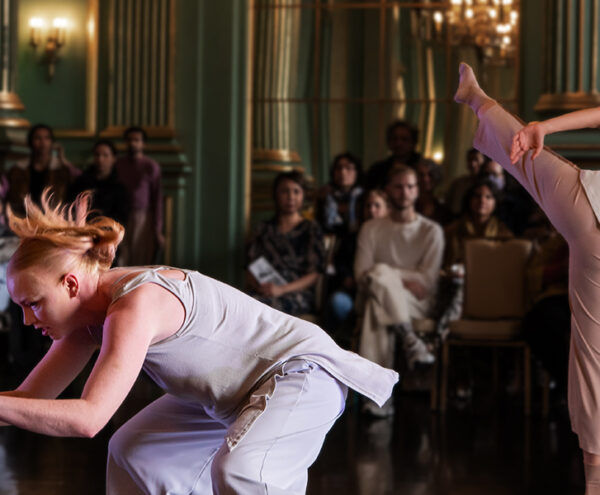
MUNA, a trio from North Carolina performed “Jiāoxiǎng Héxié,” or “Symphonic Harmony,” and created a refreshing finish to the show by utilizing a swelling, classical music score juxtaposed against house dance moves to create a sense of how opposites, such as passion and discipline, create harmony. Throughout the piece, moves and music and costumes that seem incongruous but created balance – formal and informal, fast and slow, colorful and stark– all become a kind of harmony.
The krump performers of Cie Konzi – whose members hail from Belgium, Spain, France and Senegal – used their performance, Blind, to express the cost of political and societal trauma on the body. In preparation for this piece, the dancers rehearsed blindfolded to heighten their other senses. Using a stark overhead spotlight to illuminate the five dancers, the signature hulking aggressive moves of krump created a sensation of the bodies on stage being under constant attack and constantly needing to respond – to duck or step back or attack in return. At first, the spotlight created entrapment; the ensemble could not leave their circle of light, even as it expanded and moved across the stage. They had to travel with it. Though they did eventually move about the larger “world,” where they appeared isolated in their struggles against the winds rocking them through various duets and solos. In the end, they clustered back into a narrow spotlight downstage left, with their arms outstretched in all directions and continuously knocked each other’s outstretched arms down. Each character systemically became exhausted from the struggle and disappeared until just two remained – a man who stood behind his partner and repeatedly provoked her with shoves and prodings. Her body jerked and whipped in response until he disappeared and the woman eventually remained in the spotlight alone, vibrating with the collective impact all these bodies had endured until the light faded.
The lone soloist of the night, Son of Iran, from Norway, dedicated his performance, Nafas or Breath in Persian, to the women of Iran. At first, these women were represented only by the presence of a veil left piled in the corner. The performer began break-dancing to very upbeat music, seemingly performing a work entirely incongruous with his title and the veil on stage. Suddenly his movement stopped and the voice of a woman recounting what she’d been forbidden, including the freedom to dance, filled the room while the dancer remained still and then donned the veil momentarily. Then suddenly the music shifted to (presumably Persian) folk music. The dancer removed his shirt and the quality of his movement shifted to something more fluid and languid and feminine, his limbs curling and uncurling in what looked to be an Iranian folk dance, before he dropped back into breakdance and inverted into a head spin that might break a world record for duration.
The second krump piece of the night, Hereditary, performed by the duo CREATE4, explored toxic masculinity and how it is impressed into a body and enforced. The piece opened with two men in separate spotlights, one red and one blue. They remained facing the audience for much of the performance, receiving a kind of violent madness from the world and responding with violence and madness in kind. Their dancing prowess even included an airborne horizontal double rotation. Notably, even when they faced each other and engaged in touch, it wasn’t to comfort but to reinforce the experiences and memories of the other without healing.

The local talent provided the showcase with a lot of levity and hope. Destiny Arts of Oakland brought all the love, energy and vitality of the Bay Area energy that one might desire, with their gorgeous training and hair whipping in We Represent the Bay Area. Str8jacket revitalized Abject/Accept, a piece that starts out with the ensemble creating glitchy and edgy movements that soften towards a more open routine in which the dancers draw towards a unified collective at the end. Micaya’s company SoulForce restaged Whitney Wonderland, a crowd pleasing drama that is equal parts comedic theater and hip hop which features one of the most hilarious mock-fight scenes I’ve ever witnessed. During this fight, the world’s worst behaved dance student has it out with her teacher and when the class reconvenes, they perform a mash-up of different renditions of Whitney Houston’s I Wanna Dance with Somebody. The result is hilarious, and placed in the middle of the show, it was the perfect palate cleanser to the intense and gorgeous work of the other groups.
###


Comments