Concept Series

Presented by RAWDance
November 21-22, 2025
The Green Room, Veteran's War Memorial Building, San Francisco
By Kristen Cosby
Concept Series, for those who do not yet know and love it well, is the brainchild of Wendy Rein and Ryan Smith of RAWDance. Created for the purpose of offering a stage to choreographers with works in progress at all phases of development, the program can range from re-stagings to pieces that are fresh out of the studio. “And I mean very fresh!” commented Ryan Smith as he introduced the 3pm showing in the Green Room of the Veterans War Memorial Building on Saturday, November 22nd. Fresh but exciting. Concept Series is always an intimate event that reveals something stunning. Saturday’s matinee was standing-room only and the attendants demonstrated what a great family event this program can be. So great that the hosts ran out of popcorn (also a staple of the series).
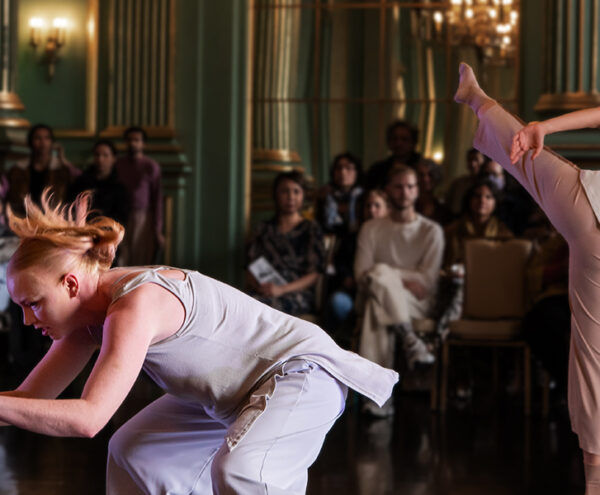
Five choreographic teams presented new works and Margaret Jenkins Dance Company restaged excerpts of their current production of Wheel for an incredible culmination. Wheel: the Wheel of Currents & the Wheel of Winds made its debut at Z-Space earlier this season and will be restaged at Shack 15 on December 11th. The restaging of the piece has offered opportunities for reordering the choreography, and Jenkins has used that opportunity to deepen and explore the world of the piece. Her dancers appear on stage in white and red costumes that suggest we are in a futuristic landscape. In its excerpted form, dancer Allegra Bautista leads the ensemble in a slow building wave that eventually populates the whole stage. The show’s long run and its reordering has given the dancers an opportunity to dig into their characters, notes dancer Carolina Czechowska. Once gathered, each member of the ensemble performs a unique choreography. A tricky negotiation on a small dance floor when performing in the round. The impression is that these characters are individually searching, living, exploring through this landscape.
When the scene and the music shift, the ensemble's movements unify, they face the same direction, as if awaiting something magnificent, and build into what feels like a very dignified community celebration that rides on waves of energy to the Barbatuques’ “Baiana.” The celebration is arrested when the music periodically and abruptly halts. That stopping creates a delicious kind of tension, like a game of red-light-green-light. We don’t know why the celebration stops, but it asks a viewer to value that celebration and what came before it all the more, since we don’t know when or how things will end. We get the sense that the finale will be abrupt and it is, stunningly so. It leaves the viewer with the feeling that this celebration – that all celebrations– are important, that without it all the struggle to live within a society matters less.
*
One of the quiet, well developed pieces of the night was SanSan Kwan’s How to Make Passive Dance. The piece moved quietly, opening to moody cello notes by Zoe Keating. A lone dancer raises her fingers in a pinching gesture that she regards and and then follows about the stage as if she were holding a light or a message aloft. One by one the other women emerge, they dance in slow unison, with arms outstretched and palms flipped up. There was duet at the center of the changed energy, with one woman lifting another – her body inverted and rigid for a moment before being set down. Where they are and what they are doing is unclear, at the end when they halted, I felt as if five women had gathered in a park and broken into dance at the sight of their friend’s lofted hand. In the end the unison returns but with all dancers facing in different directions, their hands in their pockets, standing casually all looking up at the sky.
*
In Pas de Deux in E Minor by RAWdance, Kelly Del Rosario and Julliann Witt presented a tender and moving duet with plenty of dramatic lifts. In what felt like a very traditional ballet-base piece, the surprise and beauty of which was the insertion of floorwork. Several interludes from the choreography were unexpectedly performed at a lower level allowing people to see lifts and formations from different angles. This perspective, especially on a small in-the-round performance space, made the tenderness and the drama of these lifts more powerful. While clearly new to the dancers, the piece was a crowd favorite.
*
Janesta Edmonds and her co-creator Jess Deville dramatized and danced a spiritual ritual that bound the room in silence over its poignancy. That she brought a clear pitcher of what looked like blood onto the stage and either danced with it or kept it in our presence throughout, didn’t hurt. While dancing was a smaller part of the ritual than in other pieces of the night, Janesta’s spoken and recorded words provided the context we needed to understand the piece’s intention. “I aim to plant my audience into ritual,” she announced at the start. We would all be participating in a ritual together from her traditions.
The front row of the audience would be invited to participate in this ritual with packets of seeds, which Edmonds asked the audience to drop into the pitcher of blood, while asking us to conjure what we’d like to bring forth into the world? “Ashay?” she asked the audience in a call-and-response. “Ashay,” we replied. For much of the performance Edmonds and Deville moved slowly, clad in white. Edmonds held the pitcher of blood aloft. At first, she and her fellow dancer bow to each other and mirror each other's movements – kneeling on the floor and swaying to the voiceover narrating the experience of growing up within her church and the importance of blood as a symbol. Throughout the piece the choreography echoed that of a body being moved by divine spirit – whether clapping or swaying or kneeling.
*
In a statement about their piece, Beside choreographers and performers Hadassah Perry and Kira Fargas said they aimed to explore individuality and attunement and how those change when we stand beside someone. Did they ever. Where the dancers faced in this piece told the audience everything about the relationship being explored on stage. Perry and Faragas created individual characters, and eventually a couple, who invoke deep feelings in each other and from the audience around them.
At the opening they begin moving separately, facing away from each other and as they begin to move at distance, they mirror each other. Their bodies make use of mid level space, stretching limbs horizontally to the floor, stretching, reaching. But then they break mirroring, Perry disrobes a layer and then Fargas does the same. The music shifts to Chopin and their bodies and faces come so close that the audience craves for them to kiss. They move in close proximity for some time, at one point taking each other into each other's arms for that long awaited kiss. By ending, their relationship has shifted again. They proceed to the floor and sit closely, looking away from each other. The finale in which they stand side by side and slowly rotate 360 degrees in silence looking outward in the same direction, one could have heard a pin drop in the room, because the audience was so enamoured of the tension of these two women standing beside each other and all that could entail.
###


Comments